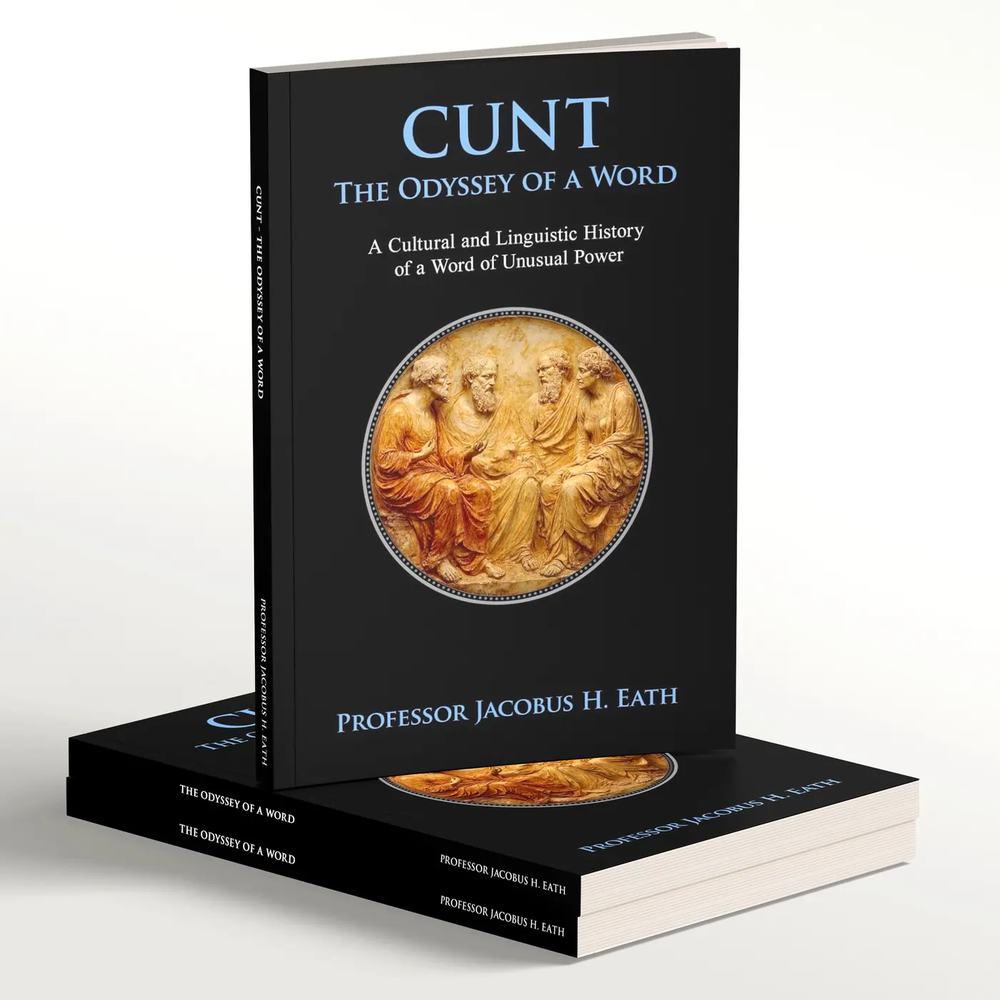
CUNT
A mock-scholarly rude word history devoted to the most notorious title in the collection.
A plain-English guide to one of the most notorious words in the English language: where it appears to have come from, why it still shocks, and why it makes such a brutally effective title for a mock-scholarly gag book.
The C-word is not a modern invention. It is generally traced back to Middle English forms such as cunte, with related forms found across older Germanic languages. Its deeper origin is still disputed, which is part of what makes the word so awkwardly fascinating: it is old, blunt, bodily and linguistically untidy.
Unlike many insults that began as metaphors, nicknames or status terms, this one starts from anatomy. That directness is one reason it has remained difficult to domesticate. It does not politely circle the subject. It simply arrives.
Words do not become offensive only because of their dictionary meaning. They become offensive because societies decide that certain subjects should be hidden, softened or euphemised. Sex, bodies, religion, class and death have all produced strong taboos in English.
The C-word sits at a particularly explosive crossing point: sex, gender, anatomy, insult, anger and social embarrassment. That gives it a charge that milder swear words do not have.
In Britain, Ireland, Australia and New Zealand, the word is often used as a fierce personal insult as well as a vulgar anatomical term. In the United States it is often treated as more specifically misogynistic and more socially radioactive. Context matters, but the risk level is always high.
That is exactly why CUNT: The Odyssey of a Word exists. It treats a word many people avoid saying aloud as something with a history, a cultural charge and an absurdly outsized power.
A mock-scholarly rude word history devoted to the most notorious title in the collection.